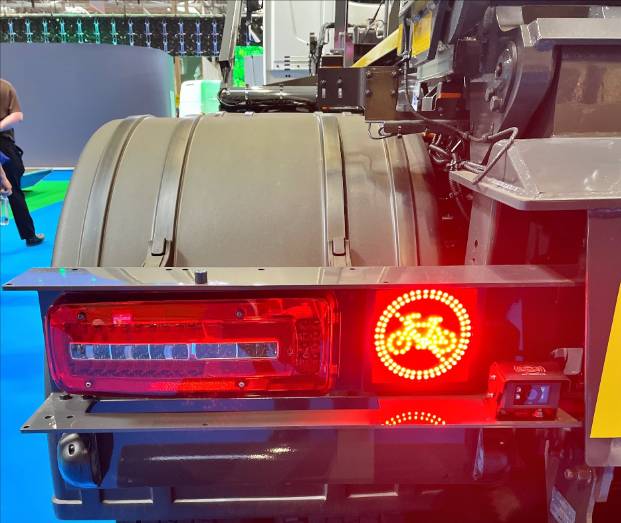
Many drivers fit aftermarket devices to their vehicles, often with the best intentions – particularly when it comes to protecting vulnerable road users like cyclists and pedestrians.
But your vehicle must be compliant, otherwise you could face enforcement action.
At DVSA we’ve noticed a worrying increase in non-compliant and illegal light fittings. This includes some Vulnerable Road User (VRU) signs, decorative lights and blue warning beacons.
VRU signs
VRU signs are devices you can buy from third-party suppliers and fit onto your vehicle. They are designed to reduce incidents involving cyclists, motorcyclists and pedestrians and your vehicle.
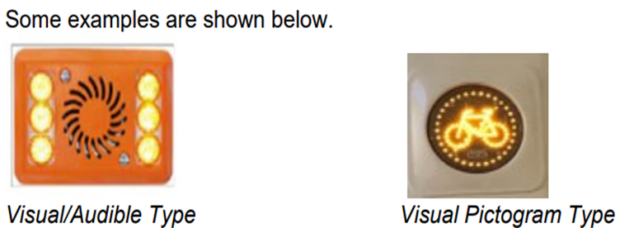
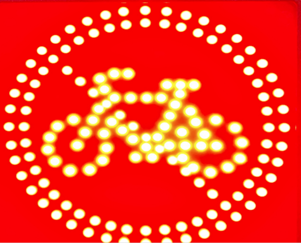
These devices display a visual warning, usually a pictogram or LED lamp, or sound an audible alert. They're typically fitted to the rear or the side of a vehicle or trailer.
Why VRU signs may not be compliant
VRU signs that work in tandem with your vehicle's indicators are classed as directional indicators. However, your signs may not be compliant, and it is an offence to use non-compliant lights.
Many devices that operate in conjunction with indicators don't meet the legal requirements because they:
- emit light of the incorrect colour - the correct colour being amber
- have the wrong flash rate- the correct flash rate is between 60 and 120 times a minute
We recommend operators, manufacturers and installers to stay up to date on our latest guidance regarding compliance.
How to stay compliant
This is not an exhaustive list, but these are examples of the requirements you must meet.
To remain compliant, you should:
- fit devices to the sides and rear of vehicles only
- not position them on side guard rails or rear underrun devices
- not increase the maximum permissible width of the vehicle
- not allow devices to protrude in a way that creates risk or danger to cyclists, pedestrians, and other road users
- use non-reflective materials
You can use the devices:
- when they are operated with the vehicle's indicators, providing they are amber in colour and flash at the same rate and in unison with the vehicle's indicators. However, your rear facing lights must be red in colour.
- where the device has an independent system, when the lighting does not flash in sequence with the vehicle's indicators and emits a continuous light.
Like you, we want to reduce the number of incidents involving vulnerable road users. However, it’s equally important that devices are fitted correctly and meet the necessary requirements.
To help operators, we will issue advisory notices at annual tests (MOT) where we see only ‘technical’ non-compliance of these devices. However, if they are fitted in a way that could be considered clearly dangerous, they will be failed at test. If the vehicle is stopped for a roadside check, other enforcement action may be taken).
For example, a VRU sign emitting a flashing red light when the indicators where operated would typically result in the issue an advisory notice. However, where the device is mounted on to the vehicle sideguard and excessively protrudes, presenting a safety risk, this would result in a test failure.
Decorative LED light displays
We've also seen an increasing trend in the use of digital LED light displays on vehicles, including HGVs. These animated displays may, for example, mimic human eyes, display messages or show emojis. In some cases, decorative coloured lights are installed inside the cab of the vehicle, behind the driver. However, these are also visible outside the vehicle and can be distracting for other road users.
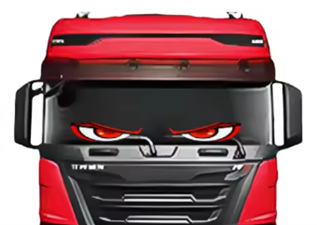
Why Decorative LED light display may not be compliant
Digital LED displays fall outside of approved lighting standards. The Department for Transport, DVSA and police forces have raised serious concerns about their use on vehicles on public roads because they:
- distract road users from critical signs, signals and surrounding traffic
- have no legal or universally understood meaning, which can confuse other road users
- could cause dangerous driving behaviour
How to stay compliant
The rules may seem quite complex in this area. We have not tried to explain the lighting regulations fully here, but some simple tips are:
- any light that shows moving images is almost certainly illegal
- any red light facing forwards is also likely to be an offence
Importantly, action can be taken even if the lights are turned off at the time. It really is best not to fit decorative LED lights to your vehicle and it is an offence to have non-compliant lights.
Blue warning beacons
We're also finding a concerning increase in the number of blue lights being fitted to HGVs as warning beacons. This is something the police will take action on if it’s discovered.
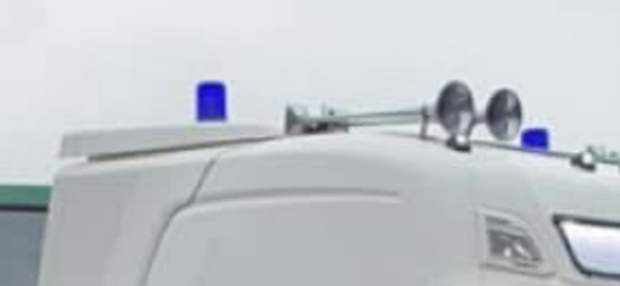
Using blue warning beacons is illegal. Only emergency vehicles are permitted to fit blue warning beacons, special warning lamps, or similar devices.
Blue lights are universally recognised as a signal for emergency vehicles. Installing them on other vehicles is illegal. Anyone caught with them faces a fine and points on their licence and could also be prosecuted.
How to stay compliant
Blue lights must not be fitted to non-emergency vehicles. If your vehicle has blue lights fitted, remove them before using the vehicle on our roads as it is an offence to use a vehicle with non-compliant lights.
Working together on road safety
Road safety remains our priority. We're committed to working with drivers and operators to make sure vehicles are compliant and safe. This reflects references made in the Road Safety Strategy (January 2026) to strengthen Commercial Vehicle Enforcement.
We welcome your feedback and questions, so please drop us a comment below.
25 comments
Comment by Perry Preston posted on
Excellent blog.
Well written and some very good valuable information.
Comment by Pat McCay posted on
Thank you very interesting reading from you and the response from the driving community. Some of your comments "could be maybe" need to be "is or is not"
Always look forward to the comments from everyone, thank you.
Comment by Robin J McBride posted on
Very helpful blog, as a HGV / PSV mechanic this clears up this issue, as different operators seem to interpret the rules differently, but still want a Clean MOT, I think the aftermarket suppliers should take heed as well as in some of their fitting instructions for side scan devices they show them fitted on to the Side Guards - which is an obvious MOT failure, and it wouldn't take much for visual warning devices to be synced to the indicators - they require writing into that circuit anyway to trigger the unit.
Comment by Jonathan posted on
I do deliveries in towns and cities when I’m reversing into sites people just don’t take any notice of my reversing lights or buzzer they walk behind the amount I’ve nearly hit was and it’s always my fault , so someone told me to fit blue flashing lights to my reversing lights it’s amazing how people who see blue lights flashing just stop and they have made a big difference but now they have said I must not use them I only had them fitted for safety reasons it’s not like I use them for other reasons ?
Comment by Julia (DVSA) posted on
Hi Jonathan. Unfortunately, it sounds like the advice you had been given was incorrect. Blue lights are only permitted on emergency vehicles. Blue lights fitted to any other vehicle which have the potential to mislead other road users, should be removed.
Comment by Jonathan posted on
Hello thanks for the reply I will have to get them removed to stay legal , the only question I have now is why are these so easy to get hold off if they are illegal why can I buy them in stores and online it doesn’t make sense to me ?
Comment by Julia (DVSA) posted on
Hi Jonathan
People can’t be sure that items advertised for sale are automatically legal to use.
While they may be legal to buy, they are not compliant with current MOT or road-use regulations.
Fitting blue flashing lights on road going vehicles is restricted to authorised emergency vehicles only, primarily police, fire, and ambulance services, along with other specially designated vehicles and organisations such as mountain rescue, bomb disposal, the RNLI.
Comment by Jonathan posted on
Hello
Ok does that mean I can fit blue lights as long as they don’t flash ? Because I do see a lot of blue lights fitted to lorry’s like side lights so they must be ok when they go though there mots .
Comment by Julia (DVSA) posted on
Hi Jonathan. You are correct, different coloured lights are often seen on vehicles. These are often:
- illegal fitments, or
- not being picked up at MOT, because they’re outside the test scope (not because they’re compliant) so passing an MOT does not mean the lights are legal.
Regulation 11 of the The Road Vehicles Lighting Regulations 1989 sets the baseline as:
- Front = not red (typically white)
- Rear = red only
- Side markers = explicitly allowed to be amber
Comment by Iain Turner posted on
Can i enquire into parking lights to LGVs over 3.5t on roads over 30mph, what are businesses using as getting alot of mixed messages. Thanks
Comment by Julia (DVSA) posted on
Hi Iain. Parking lights are fitted to most modern vehicles and are normally operated by the vehicles original switches for use in the hours of darkness. The use of the lights would be down to the user of the vehicle when parking at the roadside. More information is available in the Highway Code - Parking at night (rules 248 to 252)
Comment by Geoff Auston posted on
The whole vehicle lighting appears to be out of hand with more vehicles ,in the main ,looking like circus vehicles. Where are the old rules , the height of lighting and when they should be used. L e d lighting becomes more of a hazard being so bright.
Also the use of mobile phones and satnav devices being placed in direct view of the driver thus causing an obstruction to the driver’s view as well as being a distraction. Surely the rule should be as for testing ,
Nothing should be placed within the sweep of the vehicle’s wipers.
Comment by Richard Strong posted on
HGV's Often have excessive front light configurations ie a number of spot lights on the roof and bumper area, On a lot of roads when they activate them the drivers coming the other direction are blinded by there brightness. Why do they need so many. If they must have them they should be separately switched not come on when they flash main beam.
Comment by Simon Davey posted on
An interesting and helpful blog, many thanks.
Comment by Robert Bracegirdle posted on
I agree about blue lights. Many Lorries are showing these from the cab interior and at a distance mimic ambulance, fire or police. In addition some lorry cabs are so greatly decorated as to mimic Blackpool Illuminations. Blinding and distracting.
Comment by Colin Hughes posted on
I do agree with the principles behind this and LGVs are obviously more noticeable due to their size. In bad weather conditions I actually welcome them having additional lighting as the current regulations particularly on rear lights is far from satisfactory IMHO and needs updating to give greater visibility.
If respect of additional side marker lights creating a H&S issue, I do not agree as other parts of the vehicles construction such as mirrors protrude much more than any side lights.
Some drivers (and I held an LGV licence until I retired) are extremely proud of their trucks and like to personalise their "office" and I would not want this proposal to deter these drivers from creating these moving works of art.
Comment by Peter Adams posted on
Good, the blue lights fitted to many trucks needs to be actioned. The Police and Highways need to identify users and at a suitable safe place have Rpu stop them.
Comment by Vincent Jones posted on
About time this situation of non compliance, regarding lighting, is being dealt with, head on. Good news.
Comment by Gep posted on
This has been extremely helpful thank you.!
Comment by Iain Knight posted on
If you are interested in safety then Its hard to see how the lighting unit behind the 'eyes' image in the windscreen (shown in your blog) would not be considered a material restriction to the field of view offered and therefore illegal on that basis (inspection manual says view must not be obstructed by any changes to original design...)? Much has been made about the benefits of direct vision in recent years and Regulation 167 will soon embody that in law for new vehicles and the area that is positioned in is critical for seeing pedestrians crossing directly in front of a stationary vehicle. Manufacturers are spending billions to comply with this regulation but any device like this, or for aerodynamic or other aesthetic reasons, is immediately negating the benefit.
Comment by Julia (DVSA) posted on
Hi Iain. As part of an annual test (MOT) or roadside inspection, the driver's view of the road would be assessed and any item restricting this would attract enforcement action.
This assessment is done from the driver’s seat and due to the differing designs of vehicle dashboards it may be that these devices could be fitted without restricting a driver’s view. Each installation would have to be conducted on its own merits.
Comment by Trevor Rogers posted on
What about 'after market' lights on bicycles?
Some of the newer style led lights can look similar to a motorcycle approaching to say nothing of how they are fitted/used. If set up incorrectly or poorly fitted, they are like an extremely powerful light on high beam which can be blinding.
I understand that there are no rules for maximum brightness but I feel that this issue needs to be addressed leading to safe and compliant lighting being clearly marked and action taken against unsuitable lights..
Comment by Julia (DVSA) posted on
Hi Trevor. Cyclists are required to ensure that the lamps fitted to their bicycles do not cause undue dazzle or discomfort to other road users. Therefore, they should be securely fitted and appropriately aimed. The enforcement of road traffic laws such as the Road Vehicles Lighting Regulations is typically a police matter. More information on pedal cycles and lighting is here - https://www.gov.uk/government/publications/pedal-cycles-lighting/pedal-cycles-lighting
Comment by Trevor Rogers posted on
I don't understand the direction of your comment? - 'typically a police matter' in a similar way that 'aftermarket' light products are fitted to other vehicles.
The point is that most lights fitted to cycles are 'after market' simply because many bikes are not manufacturer fitted lights. I would think that in percentage terms there are far more cycles with poorly fitted lighting than other vehicles. Perhaps an article directed a cyclists would be helpful and when they are seen, the police should take action as a matter of priority.
Comment by Julia (DVSA) posted on
Hi Trevor. Your query is outside the remit of DVSA as this blog post is aimed at motor vehicles, rather than bicycles. Please find the following guidance, which may help you. https://www.think.gov.uk/cycle-safety/ and The Highway Code - Annex 1. You and your bicycle - Guidance - GOV.UK